
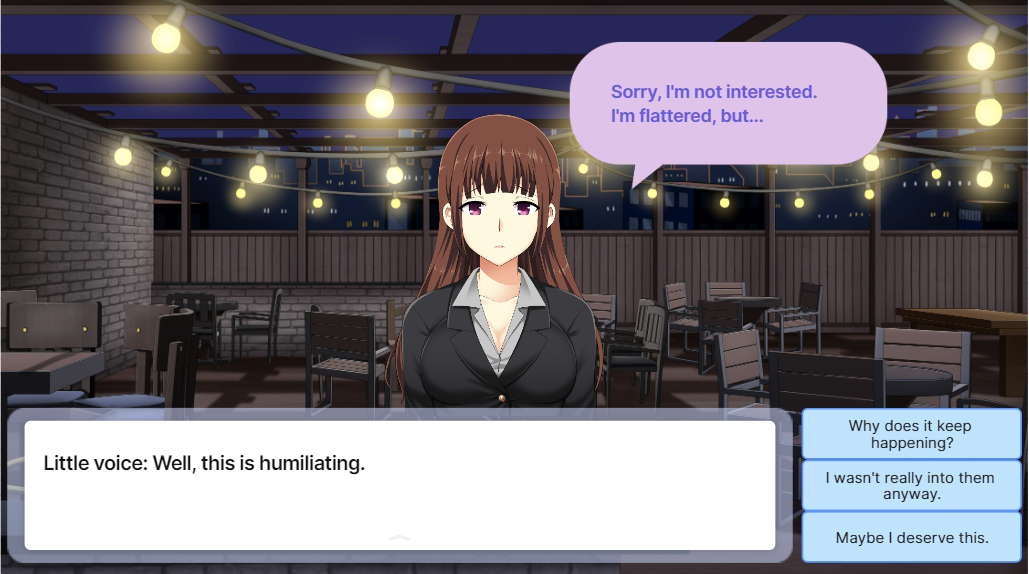
I’ve watched a lot (ahem) of reality-tv shows these past months/years, from Selling Sunset (about a real estate agency in Los Angeles) to Love Village (about Japanese folks in their late 30s/40s/50s refurbishing a house and trying to find love). I’ve also played various games featuring romantic storylines, from niche otome/amare games to recent blockbusters à la Baldur’s Gate 3. I’ve also worked on a wide range of projects over the past decade, on many characters’ stories (playable and non-playable).
The rules I’ve set myself for my research-creation project are as follows:
- Design and attempt to make series of “game sketches” or vignettes — not only prototypes, but everything around them. With a drawing analogy, it would be an annotated drawing that would leave all the construction lines visible, all the moodboards that helped to find inspiration about said drawing, and all the journaling with my doubts and ideas. It is more about learning purposes rather than the simple enjoyment of the audience at the completion of a piece. It’s more focused on practice (praxis) rather than the output (poiesis) in very broad strokes. (Maybe I won’t finish any of these prototypes during the process.) Using a sports analogy, it’s more about recording all the training steps and planned tactics, rather than focusing on a championship’s match and its results.
- Each of these sketches will be focused on a micro-level social interaction, so-to-speak. A very small interaction where a relationship becomes enacted. The idea is to leverage aspects of interactivity to scrutinize details, gestures, emotions, and give them more space/time to unravel and reveal their complexities. For example, my first vignette will be about a character hearing, processing, and reacting to someone saying “Sorry, I’m not interested” in a romantic context.
- A storytelling component — these tiny moments are full of mundane drama, and interactivity may shine some interesting light to them — something a bit different than what you would see or read with a different medium. Movies for example can use montage to highlight details, that won’t feel the same as an elaborate sentence written in a Proust’s novel, etc. One of my hypotheses is that games often highlight patterns, dynamics and structures in unique ways compared to other media.
Some of the reasoning behind these ideas:
- There are some capitalist/essentialist/colonial Western trends with storytelling in games that I’d like to challenge in my own way. There’s an obsession with growth, power, and commodification, that often goes against lots of stories I wish I could tell interactively. Modern games tell many stories about saviors bending the world to their will, using grand gestures — anything small, anything mundane, anything not quantifiable is often either discarded or glossed over.
- Whether it’s a chicken or egg situation, the player is a client/king and, as narrative designers/storytellers, there is always an implicit urge to cater their needs above anything or anyone else (Meghna Jayanth has written a lot about this already). Because these things are implicit, expectations are rarely challenged, or even understood by all the parties involved in the making (for example, what “choices that matter” do really mean in the context of a narrative game? I still have no idea, and maybe we could think about this differently.)
Why have I watched or consumed media such as reality-tv and romance-related games, where the question of rejection is often, implicitly, the worst thing that could ever happen to someone?
Even if I’m sometimes conflict-aversive in real-life, I do feel some nefarious joy watching drama being turned into a spectacle. Or maybe joy is not the appropriate word; catharsis might be one, but honestly I’m not too sure. If I’m being fully honest, I think there is something comforting in watching fucked up people doing fucked up things, because it brings me some sense of personal validation. As a marginalized individual, I’ve been rejected so many times in so many different contexts, I often need to treat this as a non-issue to cope with this; but if these people can get angry, sad, desperate over the mildest rejections, then maybe I’m allowed to be angry about it more.
Rejection is not that much seen in games at large — or at least, not from the playable perspective. As a player you are often allowed to reject others at will, without consequences; you are not often rejected though (unless the NPC is pretending to reject you, but ultimately still wants you — the “tsundere” trope). If you want something and work hard enough for it, you’ll get it — you either earn something/someone or discard it/them.
Hence I’ll flip the script on its head for funsies (and learning purposes).
At first I was tempted to have a “two-sides” scenario, where you could play as someone who needs to reject someone vs someone who needs to accept rejection. Then it felt very binary, and going against some of the rules I set above (which I will keep refining over the course of this whole PhD experiment).
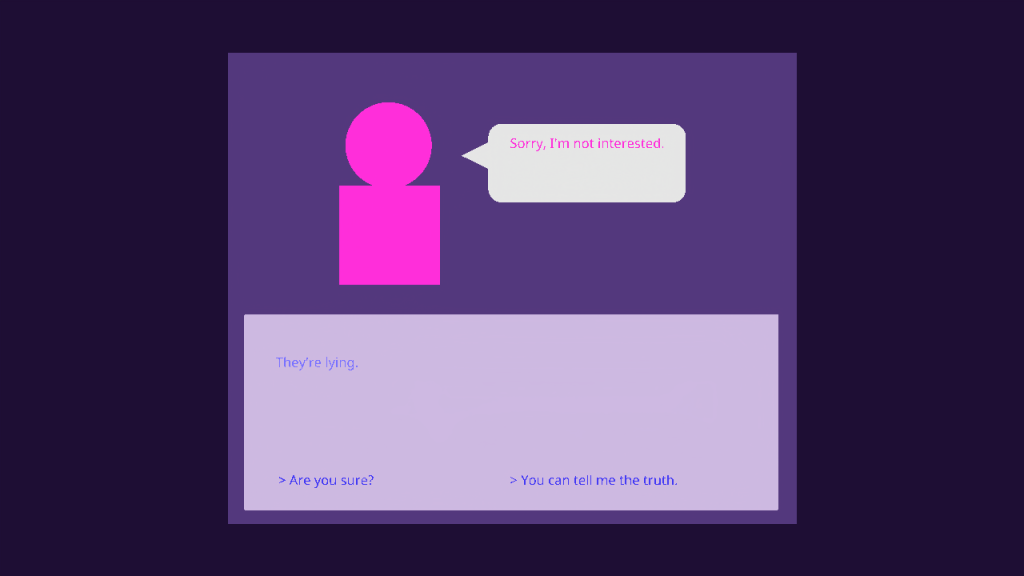
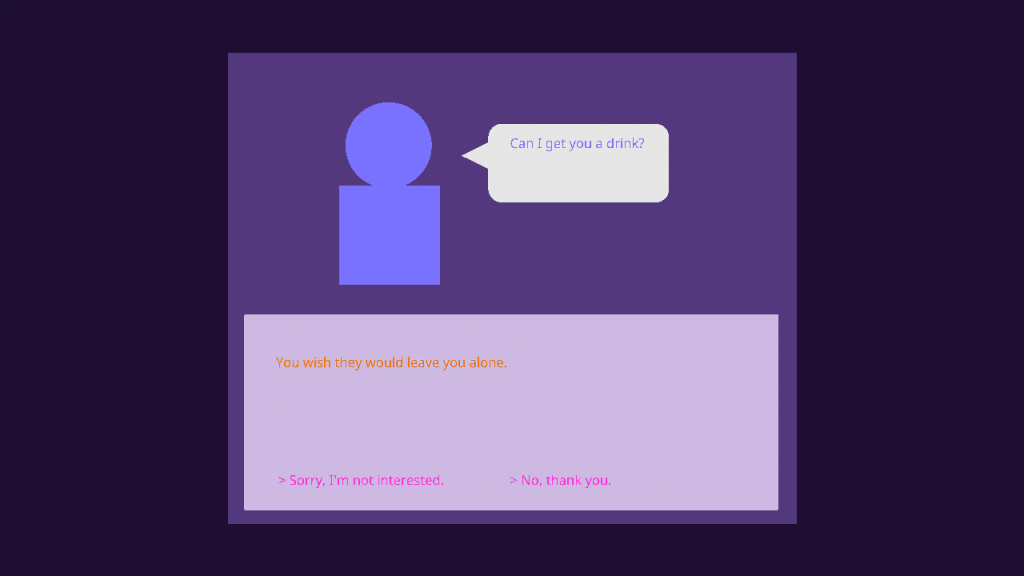
It was also missing the point actually of what rejection can feel like and why it is complex to navigate for both people involved in that sort of relationship. Rejection is not simply just the act of one person discarding someone else; I’ve seen people intentionally chasing some sort of rejection for very different reasons; I’ve also seen other people putting themselves in situations where their boundaries are constantly challenged or even trampled and it’s incredibly hard to say no; lastly I’ve seen people who keep pushing others away for reasons that had nothing to do with the other person.
So I’ve decided to treat the thing slightly differently:
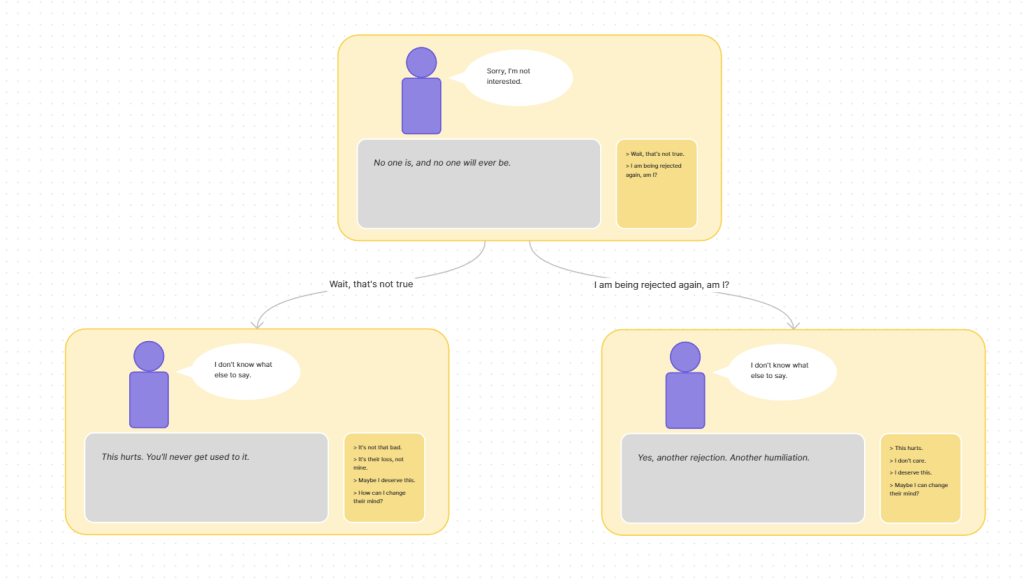
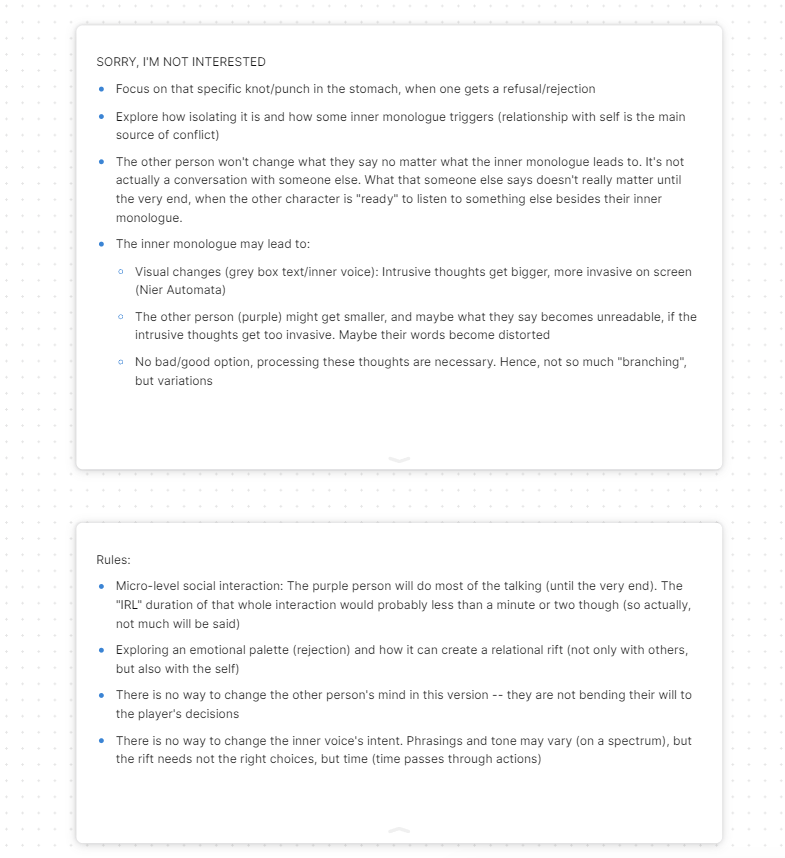
It is very hard, writing-wise, to create an interactive conversation where one of the parties involved does not actually want to talk. It gets awkward quickly. It might be because it highlights how the actions of a “playable character” are always supposed to be welcomed by the world around them; if you break that implicit rule, it creates some strange friction that we (both creators and players) are not used to deal with, especially in the context of a conversation. (Because conflicts in games are often solved in a binary way — with something being either available or not available.)
So I might cheat a bit, using a few tricks I learned about inner voices. A playthrough now looks as follows:
- A start menu where you can “Choose your love interest” with several portraits of different characters, who are conventionally attractive. I’ll probably use free assets as a start.
- Then the game starts. It borrows the aesthetics of a traditional visual novel/otome game, but your love interest quickly says: “Sorry, I’m not interested.” Of course it’s a bit of a provocative hook. Below the love interest’s portrait and dialogue is a text box that is not about what they say, but what an inner voice says — about doubts, fears, pain. Choices are about how the rejected character responds to that inner voice (with a range of options going from “what the hell” to “I deserve this”)
- Nothing one can say to their inner voice can change the decision of the love interest (the inner voice might falsely allude that you can, but actually you can’t). At the moment, I’d like to have each of these love interests have a different reason for rejecting the other character (who won’t appear on screen in my current idea, but we’ll see). No matter their reason, the other character cannot challenge them. They can only deal with their inner voice.
- The game should conclude rather quickly with maybe, one final thing the character can say to their love interest. But there is no “branching” per se, no way to do anything but to process and accept this rejection.
In terms of tools, a combination of Calico/Ink should be enough to do all this, I think I’ll start something in Godot/Ink so it’s more scalable with the other vignettes later on possibly, and I need to setup a new git repo a bit more properly for this vignette.
So there are actually more than two characters involved if we count the inner voice. Also, the conversation between the love interest and the other character is probably just a couple of lines, with the love interest doing most of the talking — the main conflict is between the character who is listening to this and their inner voice.
Why am I interested in this?
- Romantic rejection is not the worst. Or, we could challenge why it can feel the worst, and why that’s maybe not helping. Why romantic rejection feels so humiliating/soul-crushing vs being killed in games is mundane. There is a lot to unpack about why staying friends is considered a letdown, the sexual aspects of romantic rejection etc. (and the politics of putting “romance” as the ultimate goal)
- Rejection and isolation — rejection is hard because it creates a sense of isolation. It actually atomizes things because of how we’re used to deal with what we want vs what we get, but there might be other (not so binary) ways to read this. More importantly, isolation happens because the capacity to listen to someone else’s needs is threatened, somehow (in these moments we may listen to our inner voice more, while ignoring what the other party is trying to say).


Laisser un commentaire