I usually define myself as a “character-driven” type of writer. But while studying screenwriting more than a decade ago, my characters were often deemed too complex, if not downright incomprehensible. I guess it was a mix of twenty-something-me being in love with sophistication (one of the many avoidant/defensive strategies I used to have, to avoid exposing myself and my vulnerabilities through my writing) and an environment that was not equipped to understand me (as a person of color in a Western world, whose ways of expressing themself differed from your average white and wealthy person).
Throughout the years I’ve learned to be a bit more direct in my writing and designing — especially when working on games and collaborating with very different people, with various understandings of storytelling. I don’t think the characters I make are simpler now, but I know a bit more about how to make them more legible to others. I think three things can help me make my characters come across as compelling, yet not too overly complex or unfitting to the medium I’m writing for: Contrast, Contradiction, and Friction.
To be clear this is the first time I’m actually phrasing things this way — I usually write and design characters like how I cook food, by iterating a lot and adjusting things by play-tasting (heh) along the way. But while cooking is a lot about balancing flavor, texture and aroma, making interesting characters to me is often about contrast, contradiction, and friction.
Usually a story has not just one character — and even if they’re on their own, you can usually split parts of themselves into different parts, or have them interact with something that, while not being presented as directly human, may still behave as a character — hence there’s always more than one. I am thinking a lot about what a character is or can be these days; in my mind, what shapes a character primarily (and makes one distinctive from other characters) is maybe about a driving force they have (the need to do something; or there is something in them that colors their relationships in a particular way).
Then you need to limit the number of characters you have in a story. I read many classic novels with loads of characters in them, and while this is somewhat possible in books, it quickly becomes less sustainable when writing anything else (movies or games, for example). Even in novels or lengthy shows, if done poorly having too many characters can be very disorienting. The rule of thumb is, I think, that people can usually remember about 7 things at a time? In storytelling I’m usually narrowing the number of characters appearing in a scene to 2 or 3 maximum. If there are more people involved, I need to group them — and these groups form “a character” (hence they all want the same thing, at least in this scene). Unless the intent is to disorient the audience, you don’t want to present too many new information at a time — or the audience just won’t care for them. The way we engage with characters is quite complex, since a character often carries much more than one information, and is always entangled in a relationship with another “character” in a narrative context. When you see, hear, play a character, various parameters can help you understand them, or even relate to them — social cues and clichés, symbols and other outward signs, how familiar they are to something or someone you know IRL, etc.
In the context of interactive storytelling, creating compelling characters may seem even harder at times. It’s possibly because some folks have the assumption that a player’s agency can go in the way of a character’s personality and story. Like you need to give players choices that matter vs a character with a strong personality can only have a limited number of things they actually want to do in a given situation. As if you need to not only write a cool scene with 2-3 characters, you also need to take into account an invisible extra character whose drive is only about getting more — more power, more things to do, more agency in how things unfold.
To me, it’s not even about a supposedly clash between linear vs branching storylines. Challenging these assumptions is in fact one of the objectives of this research-creation project. At the moment I am exploring how what we call “narrative choices” (often a list of actions or dialogue options a player can choose at various points, which can lead to various outcomes) can be used as dramatic tools for a character’s expression, rather than a player’s expression. The consequences and outcomes are less about a player’s agency, but about a character’s agency in a given situation. So of course, if a character is an almighty tyrant who can decide the fate of entire worlds, their conflicts and dilemmas may decide the fate of many. But I don’t think having big choices is the only interesting thing that can happen in a story (interactive or not).
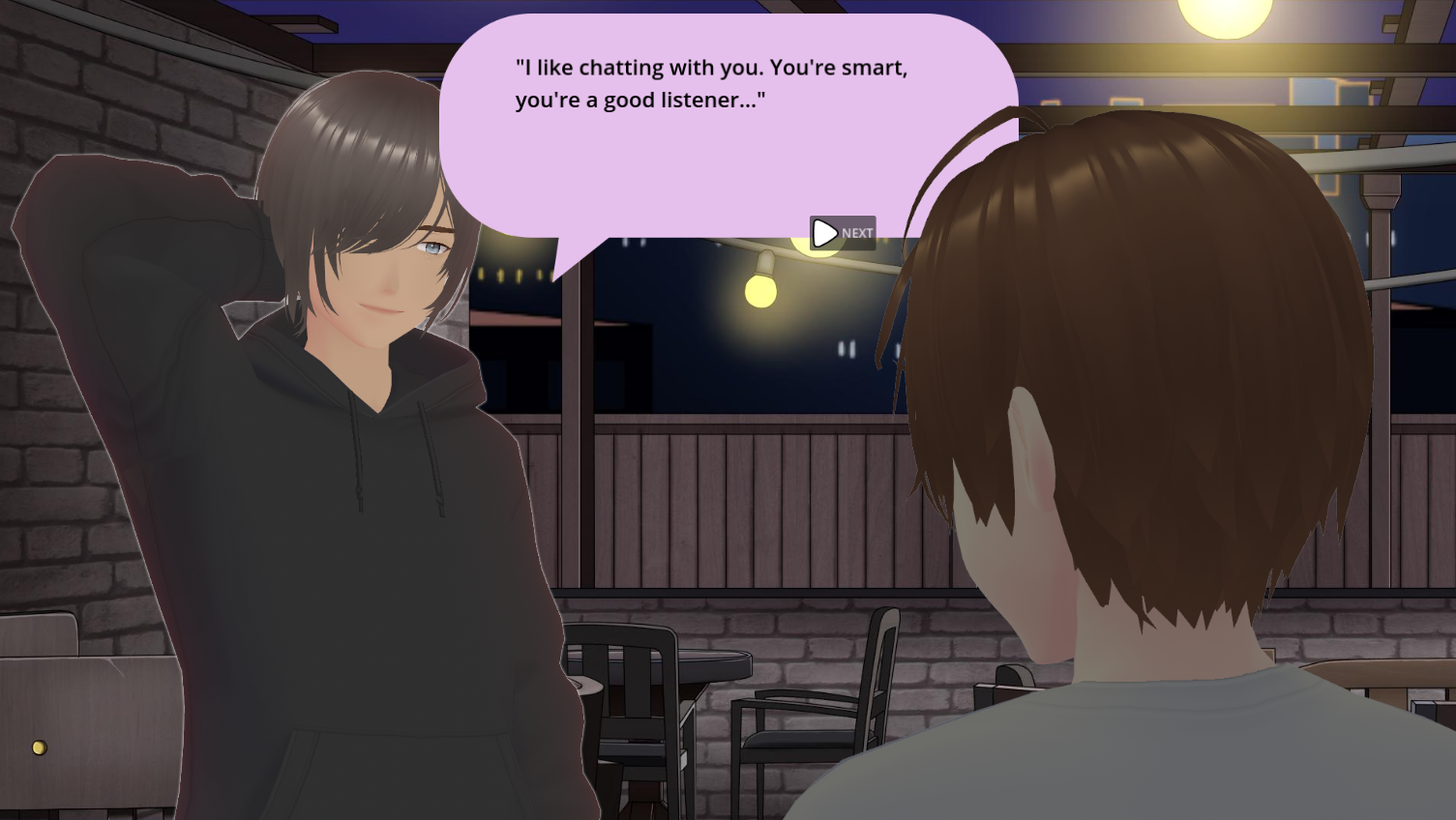
In my small lil’ interactive vignette currently named “Not interested“, I decided to create two contrasted characters (one sets clear boundaries overtly; the other is in conflict with themselves and cannot utter a thing until the very end). Romantic rejection was my starting point — and I wanted the whole experience to be somehow… tenderly cringey. The awkwardness of the situation is high, but it’s also not the end of the world. No one will die because a thing is said or a choice is made. I bounced various ideas as to where the player may have some input and how; I narrowed my options since I really want this to feel like a sketch someone would have drawn on a little notebook (raw, incomplete, but hinting at a larger story). I’m also pretty much interested in contradictions, about what we say or do can be at complete odds with what we think, and games have a unique way to showcase this (I’m still haunted by the Fish Cannery sequence in Edith Finch).
I thought briefly about that scene in Annie Hall I think? Where two characters talk to each other on screen but the subtitles intentionally say something different. Then I saw a brief reel about Brennan Lee Mulligan’s NPC being rejected by another player character in the latest season of Dungeons & Drag Queens, which really unlocked the whole idea about this “anxiety goblin” and this “whack-a-mole” situation. Choices, in my vignette, are not life-altering moments, and they won’t impact what the other character says since it’s all in someone’s head. The story is about an anxious character who needs to deal with a very awkward situation, while having their inner voice shouting random stuff in their head. It’s a whack-a-goblin situation but the goblin can’t die — the player can only temporarily whack them.
I find it funny to use “choosing an option” not as “I want this” but as “I want to shut this down”. Writing this, I’m still playing with how these goblins show up and how, to find the appropriate pacing, but I’m already finding it funny and tenderly cringe, which is what I was aiming for, hence I might stop working on this very soon and move on to the next vignette. I’m using Godot and Ink as tools, and may elaborate a bit more on this in another post.
Anyway to sum up:
- Contrast here is achieved by 3 characters behaving in opposite ways: One states their boundaries, being not romantically attracted to the other, trying to explain thoroughly why. The other is just living an inner battle with their anxiety goblin who cannot say anything before the very end. The anxiety goblin(s) is obsessive and playful and snarky. Contrast is something I’m seeing more on the outward side of things — how characters express themselves to others.
- Contradiction is at the core of the interaction, and will especially shine at the very end, once the character answers to the rejection with a simple “It’s okay.” with their head filled with voices saying the opposite. Contradiction is inward, a bit like inner conflict in my mind, but the character does not always need to be fully aware of how contradictory they are, or even to resolve such conflict.
- Friction happens between what is said, what is wanted, what is thought and what is lived. These dynamics evolve in an enclosed space (a scene, a plot) and create frictions. I guess it is a bit akin to the idea of conflict. But conflict is often loaded with power dynamics (with one force needing to overcome another). Friction is a bit more in the moment in my mind, and does not need to be resolved, especially in the context of a vignette or a small game “sketch”/micro-prototype like this one.
Pro-tip: Always reduce the number of characters you have down to 2 or 3, especially when you start a new project. Merge existing characters — chances are you are using one idea per character, and I think it’s often more compelling to deal with multifaceted characters that have maybe one core trait, but are actually riddled with contradictions that can arise depending on context and their interactions with other characters.


Leave a Reply